Antigua and Barbuda with kids: attractions, itineraries and family travel tips

Antigua and Barbuda with kids suits families who want beach time mixed with short history, nature and boat outings. Five days works for one Antigua base. Seven days gives the easiest first trip, with a weather buffer and an optional Barbuda day. Ten days makes an overnight on Barbuda realistic without turning every morning into a transfer. The main difficulty is deciding whether Barbuda belongs in this trip at all: the crossing is weather-dependent, local transport is limited, and healthcare there is much more restricted than on Antigua.
School-age children get the widest choice because they can manage fort paths, museum visits and a guided sanctuary boat. Toddlers need shorter beach sessions, shade and a pre-arranged restraint for every taxi or rental. Keep one Antigua day unbooked. That spare day is more useful than forcing a ferry, exposed coast or boat tour into unsuitable conditions.
This guide was checked against official tourism, airport, ferry, national park, law, weather, disaster, health and product sources on August 29, 2026. Suggested ages and visit lengths are editorial planning estimates, not admission or safety rules. A facility not listed by an operator is something to confirm, not something to assume.
Antigua and Barbuda family decisions at a glance
| Decision | Practical starting point |
|---|---|
| Best first base | North-west or south Antigua, depending on whether beach access or English Harbour is the priority |
| Useful trip length | Five days for Antigua; seven for Antigua plus an optional Barbuda day; ten for two island bases |
| Best ages | Six and older for the broadest choice; toddlers need shorter heat and transfer blocks |
| Car needed? | Not for a resort-style stay; useful for a self-directed island loop if the correct restraint is secured |
| Main difficulty | Weather-dependent sea travel, limited pavements and arranging child restraints |
| Barbuda decision | Day trip only for a robust ferry day; overnight for a slower beach and sanctuary plan |
| Child-restraint position | No national child-restraint provision was identified in the sources reviewed; bring or reserve an appropriate seat anyway |
| Emergency numbers | 911 for medical emergencies; 999 or 911 for police or fire assistance |
| Weather gate | Check Antigua Met, NODS and the ferry operator before a boat or exposed-coast day |
Which Antigua and Barbuda attractions fit your children?
| Image | Destination | Best ages | Indoor or outdoor | Allow | Book ahead? | Best base |
|---|---|---|---|---|---|---|
 | Dickenson Bay | All ages with close supervision | Outdoor beach | 2 to 3 hours | No; equipment varies | North-west Antigua |
 | Museum of Antigua and Barbuda | 6 and older | Indoor museum | 60 to 90 minutes | Check current access | St John's |
 | Nelson's Dockyard | 6 and older | Outdoor heritage site with interiors | 2 to 3 hours | Sensible in busy periods | English Harbour |
 | Dow's Hill Interpretation Centre | 7 and older | Indoor presentation and outdoor view | 60 to 90 minutes | Check presentation times | English Harbour |
 | Betty's Hope | 7 and older | Outdoor historic site | 60 to 90 minutes | Check before driving | Central Antigua |
 | Devil's Bridge | 8 and older for the viewpoint | Exposed outdoor coast | 30 to 45 minutes | No; use a guide if uncertain | East Antigua |
 | Frigate Bird Sanctuary | 6 and older on a suitable marine day | Guided boat and wildlife | 2 to 3 hours | Yes | Codrington, Barbuda |
 | Low Bay | All ages with same-day sea checks | Outdoor beach | 2 to 3 hours | Arrange local transport | Barbuda |
The age column is a planning filter, not a promise. Confirm weather, life jackets, toilets, food, shade, seating, stroller storage and changing space for your date, especially on Barbuda.
What parents ask before booking
Public family discussions repeatedly return to these ten decisions. The answers below use official transport, weather, health and venue sources rather than forum claims.
- Should we stay on Antigua or Barbuda? Use Antigua for the airport, broader transport, healthcare and the greatest range of short outings. Sleep on Barbuda only when a quieter second island matters enough to justify the sea or air transfer and limited services.
- Is the Barbuda ferry worth it with children? It can be, but the operator says the roughly 90-minute crossing can be rough enough to cause motion sickness and can be cancelled. A child who struggles on boats needs an alternative Antigua day, not a non-refundable itinerary built around one sailing.
- Do we need a rental car? No for a beach-led stay with pre-booked taxis. A car is useful for Nelson's Dockyard, Betty's Hope and the east coast on separate days, provided the driver is comfortable driving left and the correct child restraint is secured.
- Can we use public buses with a stroller? Buses serve routes from St John's, but official tourism guidance describes schedules as unpredictable and Barbuda has no public transit. Do not build an airport, ferry or timed-attraction connection around a bus.
- Which coast is best for young swimmers? Start by choosing a sheltered-looking beach near your base, then make the swimming decision from that day's wind, surf, flags and local advice. A west-facing beach is not automatically safe, and an east-coast viewpoint is not a swimming recommendation.
- What is there to do beyond a resort? Combine the Museum, Nelson's Dockyard, Dow's Hill, Betty's Hope and one weather-appropriate nature day. They work better as short anchors than as a checklist completed in one island circuit.
- Will toddlers enjoy the historic sites? They may enjoy open space and boats more than interpretation. Give a toddler one 45-minute heritage stop, a snack and a shaded reset rather than pairing three ruins in the midday heat.
- How much should we schedule? One booked morning and one optional late-afternoon stop is enough. Keep the middle of the day for food, sleep and weather changes.
- What if seaweed, rain or rough water affects the beach? Move to the Museum, English Harbour interpretation or the spare day. Seaweed and water conditions vary by beach and date, so a country-wide seasonal promise is not useful.
- What changes on Barbuda? Transport, supplies and healthcare are limited. Carry water, sun and mosquito protection, required medicines, ferry details and a way to contact the guide; do not assume Antigua's services are minutes away.
North-west Antigua and St John's
This is the easiest cluster for an arrival or departure day. Dickenson Bay supplies a short beach block, while the Museum turns a hot or wet morning into a manageable city visit. Use approved airport taxis from V. C. Bird International Airport and agree on the restraint before pickup.
Dickenson Bay
Children can paddle, play on sand and watch small boats without committing to a full-day excursion. All ages can use the beach, but the correct fit depends on same-day sea conditions and the adult-to-child ratio. Allow two to three hours, preferably outside the strongest midday sun.
Sand makes an ordinary stroller awkward; a carrier or beach trolley may be easier. Public beach access does not guarantee a changing table, lifeguard, toilet, food outlet, shade or child-size flotation equipment. Ask your accommodation or chosen operator what is open, and bring water and portable shade rather than relying on a photograph.
No attraction ticket is needed for the beach itself. Water sports, chairs and equipment are separate services and should be booked only after confirming age limits, life jackets, insurance and weather cancellation. If wind, surf or visibility deteriorates, use the Museum instead of moving children farther into the water.
The practical arrival point is by taxi or car; there is no rail stop and public buses are not suitable for a timed family transfer. Read the official tourism site for current destination information. Details checked August 29, 2026.
Museum of Antigua and Barbuda
Children see island history in a compact former courthouse rather than across an exposed ruin. School-age children are the clearest fit; younger children may manage a short circuit if the adult chooses two or three objects to discuss. Allow 60 to 90 minutes.
The museum is indoors, but a historic building should not be assumed to provide full step-free circulation. Ask about entrance steps, stroller storage and accessible toilets before arrival. The government cultural page does not promise a cafe, changing table or dedicated family seating, so plan food and baby care elsewhere in St John's.
Check current opening access before travelling because published schedules can change. This is the strongest rain or heat backup in the guide, though severe weather can still affect city travel. Cruise-ship days can make central St John's busier, so choose an early visit and keep the rest of the morning flexible.
The museum is in central St John's. Arrive by taxi, car or a walk only when your route has usable pavements and the heat is manageable. Read the government cultural profile of the Museum of Antigua and Barbuda. Details checked August 29, 2026.
English Harbour and the south
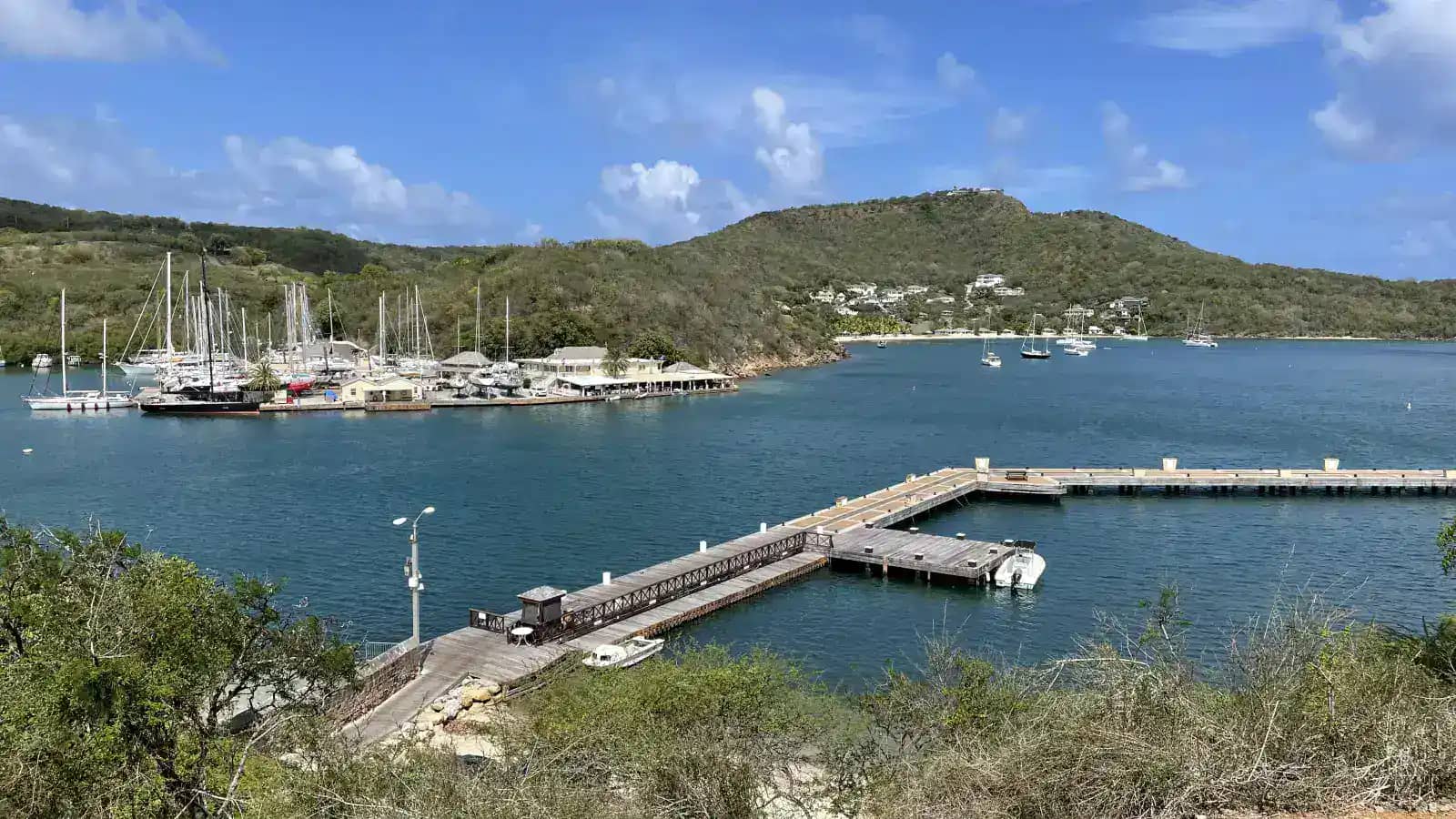
Nelson's Dockyard and Dow's Hill belong on the same day because they share the English Harbour area. Start at one, stop for a real meal and decide whether the second still suits the children. A family does not gain anything by adding another distant attraction before dinner.
Nelson's Dockyard
Children walk among historic dockyard buildings, boats and harbour spaces while adults explain how the naval base functioned. Ages six and older are likely to get the most from the setting. Allow two to three hours, shorter with a toddler or in high heat.
Some surfaces are historic and uneven, so stroller comfort and step-free access vary by route and building. The wider harbour area has food and seating options, but the existence, location and opening of toilets, changing space and shaded rest points should be confirmed for the ticketed area. Carry water between buildings.
Check current National Parks access and any ticket arrangements before setting out. Morning is usually the more manageable outdoor window. Rain can make stone and timber surfaces slippery, while a busy harbour event can change parking and crowd levels.
The useful arrival is Nelson's Dockyard in English Harbour by car or pre-arranged taxi. Do not depend on a precise public-bus connection for a booked entry. Read National Parks Antigua for official visitor information. Details checked August 29, 2026.
Dow's Hill Interpretation Centre
Children use the interpretation presentation to connect the landscape with the island's history, then look across English Harbour from the hill. Ages seven and older are the clearest fit. Allow 60 to 90 minutes and treat it as a complement to the Dockyard, not another half-day attraction.
The centre combines an indoor component with an elevated outdoor setting. Ask about stairs, step-free access, stroller parking, toilets and seating for the exact presentation. Do not assume food, baby-changing space or continuous shade; use the Dockyard area for a planned meal.
Check presentation times and admission before arrival. Wind, rain or low visibility can reduce the value of the lookout even when the indoor element remains available. If children are tired after the Dockyard, move Dow's Hill to another morning rather than rushing uphill.
Reach Dow's Hill by car or taxi from English Harbour; it is not a practical stroller walk from the Dockyard in the heat. Read the official Dow's Hill Interpretation Centre page. Details checked August 29, 2026.
Central and east Antigua
Betty's Hope and Devil's Bridge can share a day only with an early start and a long break. Both are exposed. Betty's Hope is the learning stop; Devil's Bridge is a brief geology viewpoint where the adult's main job is controlling distance from the edge and water.
Betty's Hope
Children inspect the stone windmill and use the plantation site to ask how sugar was produced and whose forced labour made the system possible. This requires honest, age-appropriate context; it is not simply a picturesque windmill stop. Ages seven and older are the clearest fit. Allow 60 to 90 minutes.
The ground is outdoor and can be rough, so a carrier may work better than a small-wheeled stroller. Confirm the current route, interpretation access, toilets and any step-free sections before driving. Do not count on a cafe, changing table, reliable shade or extensive seating; bring water and leave before the hottest part of the day.
Check National Parks information and current access in advance. Rain can make ground slippery, while sun and wind can turn a short visit into a tiring one. If interpretation is unavailable, do not fill the gap with invented stories; use the visible site and discuss only what your verified material supports.
Betty's Hope is most practical by car or taxi. There is no useful rail stop and no timed public connection to rely on. Read National Parks Antigua for current official information. Details checked August 29, 2026.
Devil's Bridge
Children see a natural limestone arch and wave-cut coast. This is a geology viewpoint, not a climbing or swimming activity. Ages eight and older are the planning fit used here because younger children can be difficult to control near an exposed edge, but every child needs an adult within reach. Allow 30 to 45 minutes.
The ground is uneven, sharp and exposed, making a stroller unsuitable beyond any established parking approach. Do not expect toilets, food, changing facilities, shade, railings or seating at the viewpoint. Closed shoes, water and strict boundaries matter more than completing a particular photo angle.
Do not visit when waves, wind, rain or visibility make the coast hard to read. Stay off wet rock and away from the arch edge; an official attraction listing is not an assurance that conditions are suitable. A guide is sensible if the family is uncertain about the approach.
Reach Devil's Bridge by car, taxi or organized tour and agree on the return before leaving the vehicle. The official Antigua and Barbuda tours and attractions guide includes the site. Details checked August 29, 2026.
Barbuda: sanctuary and Low Bay
Barbuda should be a deliberate second-island plan, not an extra attraction squeezed into an Antigua day. Sea Bridge describes the crossing as roughly 90 minutes and warns that rough seas can cause motion sickness or cancellation. Confirm the sailing, return, luggage, folded-stroller acceptance and local transfer before paying for another activity.
Frigate Bird Sanctuary
Children travel by small guided boat into Codrington Lagoon and watch nesting or flying frigatebirds. The official tourism page says the sanctuary is reached only by guided boat. Ages six and older are the clearest fit because children need to sit safely, follow instructions and tolerate sun and spray. Allow two to three hours after reaching Barbuda.
A stroller has no useful role on the sanctuary boat; ask where it can be stored. Confirm child-size life jackets, boarding steps, toilet access before departure, drinking water, shade and seating with the licensed guide. Do not assume food, changing space or an accessible landing inside the lagoon.
Advance booking is essential. Marine weather, wind and lagoon conditions determine whether the trip runs, and wildlife sightings are never guaranteed. The frigatebird image in this guide is a representative photograph of the species taken in Antigua, not a claim that the camera was inside the sanctuary.
Arrange pickup from the Barbuda ferry or airport and confirm the return connection. There is no public transit on Barbuda. Read the official Frigate Bird Sanctuary page. Details checked August 29, 2026.
Low Bay
Children can walk and play on a long stretch of sand after the sanctuary or as the main purpose of a slower Barbuda stay. All ages can enjoy the shore, but swimming depends on same-day conditions, local advice and close supervision. Allow two to three hours rather than assuming an unbroken full beach day.
Sand, boat transfers and limited local transport make a stroller awkward; use a carrier for a young child. Confirm toilets, shade, drinking water, food, seating and a changing plan with the guide or accommodation before leaving Codrington. Carry required medicines because Barbuda's healthcare options are extremely limited.
No general beach ticket is required, but local boat or road access must be arranged. The tourism authority notes that pink shell coloration is seasonal, so do not promise children that every section will look pink on every date. Wind, surf and seaweed can change the usable part of the shore.
Reach Low Bay through a pre-arranged Barbuda guide, boat or vehicle; there is no public-bus stop. Read the official Barbuda attractions overview. Details checked August 29, 2026.
Five, seven and ten-day family itineraries
These routes assume slower mornings, one meaningful meal break and no more than one major booking a day. Swap days rather than stacking missed activities after bad weather.
Five days: one Antigua base
- Day 1: Airport transfer, food and a short beach look. No attraction booking.
- Day 2: Dickenson Bay or another near-base beach for two hours, then a long indoor rest.
- Day 3: Nelson's Dockyard in the morning; Dow's Hill only if everyone still has energy.
- Day 4: Museum of Antigua and Barbuda, lunch, then an unplanned afternoon.
- Day 5: Choose Betty's Hope or Devil's Bridge from the weather, not both before a flight.
Seven days: Antigua plus a conditional Barbuda day
Use the five-day route, add a completely open weather-buffer day, and reserve one day for Barbuda only when the ferry and marine forecast are suitable. If the crossing is cancelled, use the spare day for the missed central or east Antigua stop. Families with motion-sensitive children can replace Barbuda with a second slow beach morning and English Harbour at a gentler pace.
Ten days: two islands without rushing
- Days 1 to 5: Antigua arrival, north-west beach, St John's, English Harbour and one central/east history day.
- Day 6: Rest, laundry and no long vehicle trip.
- Day 7: Transfer to Barbuda by confirmed ferry or flight; settle in rather than touring immediately.
- Day 8: Frigate Bird Sanctuary if marine conditions permit; otherwise keep the day local.
- Day 9: Low Bay with a pre-arranged return and supplies.
- Day 10: Return connection with enough margin for disruption. Do not place an international flight immediately after an unprotected sea transfer.
Getting around both islands with children
Airport, taxis and rental cars
V. C. Bird International Airport lists approved taxi providers whose drivers are uniformed and badged. Confirm the total fare, vehicle size and child restraint before entering. A taxi queue is not evidence that an appropriate infant or booster seat is available.
Official tourism guidance says driving is on the left and that Antigua can often be crossed in about 45 minutes or less. That estimate is useful for scale, not for a timed family promise. Narrow roads, stops, weather and finding the correct entrance can extend a trip. A rental car is most valuable when a family wants independent access to English Harbour, Betty's Hope and the east coast.
Child restraints
The Antigua and Barbuda Road Traffic Act reviewed for this guide did not contain a national child-restraint provision, and PAHO's country profile did not identify a national child-restraint law. That absence is not safety advice. The CDC recommends bringing an age- and size-appropriate child or booster seat because suitable seats may be limited or unavailable.
Reserve the exact restraint in writing, ask how it will be installed and reject a vehicle that cannot carry the child correctly. Keep the same rule for airport taxis, day tours and rental cars even when a driver says the law does not require it.
Buses, ferries, luggage and strollers
Buses mainly depart from East and West Bus Stations in St John's. Official tourism guidance says schedules can be unpredictable and services generally run during daytime hours. Use them for a flexible outing, not for an airport, ferry or prepaid attraction connection. Few roads have continuous pavements, so the walk after the bus may be the hardest part with a stroller.
Sea Bridge operates the Antigua-Barbuda ferry service and describes a crossing of about 90 minutes. Rough seas can cause motion sickness or cancellation. Ask the operator about the exact terminal, check-in time, child fare, life jackets, baggage, car seats, folded strollers and same-day return before booking. Barbuda has no public transit, so reserve a local guide or vehicle separately.
Family logistics
Seasons, storms and sea conditions
The Atlantic hurricane season runs from June through November. That does not mean every day is stormy, and travelling outside it does not guarantee calm water. Check Antigua Met and the National Office of Disaster Services each morning, then check the ferry or boat operator for the specific route.
Common Christmas, New Year, Easter and school-holiday weeks can increase demand for rooms, vehicles and excursions. Book the scarce component, such as the right car seat or a licensed Barbuda guide, before filling the itinerary with flexible beach time.
Family meals, drinking water and midday heat
Do not plan around one universal Antiguan meal time. With young children, confirm the kitchen schedule near the accommodation and carry a simple snack for road and boat days. On Barbuda, arrange food and water before leaving Codrington or the accommodation rather than expecting a venue cafe.
US travel guidance says tap water is generally safe but may not be available every day. Follow current local advice and keep drinking water in the room and vehicle. Heat, sun and mosquitoes are more predictable family problems than finding one more attraction: use shade, hats, repellent and a slow middle of the day.
Healthcare, emergency help and accessibility
Call 911 for a medical emergency. Police or fire assistance can be reached through 999 or 911. Antigua has the country's main healthcare services; Government of Canada guidance describes healthcare on Barbuda as extremely limited and notes that serious illness or injury may require medical evacuation. Travel insurance should cover the activities and evacuation risk in the actual itinerary.
Accessibility is inconsistent. Historic surfaces, limited pavements, sand, boats and exposed coastal ground can all interrupt a step-free route. Ask the venue or operator about the exact entrance, toilet, boarding and vehicle transfer rather than accepting a broad claim that an attraction is accessible.
Useful digital tools
- Antigua Met: use the official site for current forecasts and warnings before beach, road and boat decisions.
- NODS: save the National Office of Disaster Services hurricane and hazard pages for official preparedness information.
- Sea Bridge: keep the live ferry contact and sailing details available; a saved old timetable is not enough.
- Offline maps: download Antigua and Barbuda before arrival. A map helps with a driver or guide, but it does not turn an unpaved or private route into public access.
- Airline app or mobile site: keep boarding passes and disruption notices available offline as well as on the phone.
- Family messaging: agree on one group and one meeting point. Large families should not depend on every child having a separate data plan.
English is the official language, so a translation app is less important than current transport, weather and operator information. Download confirmations and emergency details because coverage can weaken on remote coastlines or during a boat trip.
Data for ferry changes, weather checks and family messages
Families use data here for airport messages, approved taxi contacts, offline-map updates, weather warnings, ferry changes and attraction tickets. A Roaming eSIM for Antigua and Barbuda is the exact-country commercial option. A family continuing to another destination listed on the same plan can compare the Caribbean Roaming eSIM. The regional label is not a substitute for checking every country on the live coverage list.
The public catalog returned ten Antigua and Barbuda plans on August 29, 2026. It showed fixed and daily formats, Flow with 4G in the coverage records, and top-up support on nine of the ten plans. One daily plan did not support top-up, so this guide does not claim that every Roaming eSIM can be reloaded. Signal still depends on the listed network, device, terrain and local conditions.
That live destination and package evidence is Roaming eSIM's practical edge over a generic travel-data news story: families can inspect the current route, plan format, coverage record and top-up field before checkout instead of acting on a temporary headline. It is not a claim that Roaming eSIM is always cheaper or faster than every alternative. Use the travel data calculator, confirm phone compatibility, and read the pre-travel installation guide before departure.
Only two product cards appear below because only the exact-country and Caribbean catalog records reviewed for this guide explicitly included AG. Fewer verified cards are more useful than implying coverage from an unrelated global label.
Hero: English Harbour by Vincent van Zeijst, CC BY-SA 4.0. Dickenson Bay by Josh Dobson, museum and Nelson's Dockyard by David Stanley, and Devil's Bridge by Z_dead, all CC BY 2.0. Dow's Hill by Balou46, Betty's Hope by Paul Harrison and the representative frigatebird by Charles J. Sharp, all CC BY-SA 4.0. Barbuda beach by Yan Renucci, CC BY 3.0. Source pages are recorded in the article metadata and research evidence.