Bangkok flooding travel update: airports, trains and roads
Suvarnabhumi and Don Mueang airports remain open. Bangkok's Airport Rail Link, Red Line, BTS and MRT are operating, but flooded roads are making some journeys slow or impractical. Travelers using Don Mueang should note that metered taxis are temporarily unavailable. State Railway Eastern Line services are suspended, while the Northern Line has reopened.

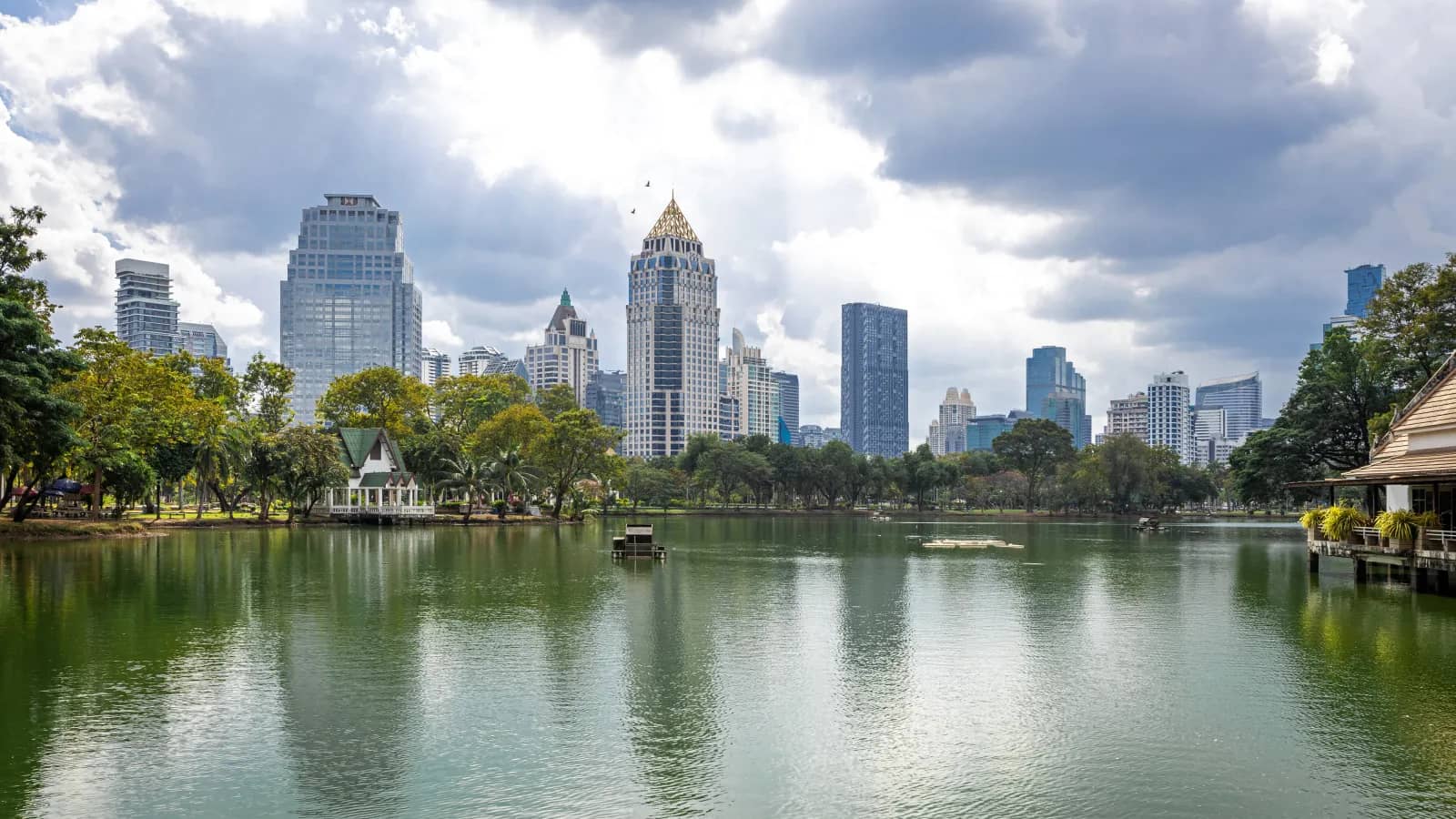
*Original OpenSim editorial image. It represents a flood-affected Bangkok journey and does not show a named road, station or current water depth.*
Latest official visitor update checked: 6:00 p.m. ICT on September 27, 2026. Airports and urban rail are operating, but local conditions can change street by street. Check the route immediately before leaving rather than relying on a morning screenshot or a report from another neighborhood.
Bangkok received nearly 300 mm of rain over 48 hours from September 24, according to the city's governor. Floodwater was beginning to recede in some areas on September 27, but authorities continued to report road disruption and further rain risk.
Bangkok flood travel status at a glance
| Service or journey | Status in the latest official update | What travelers should do |
|---|---|---|
| Suvarnabhumi Airport (BKK) | Open and operating | Prefer Airport Rail Link where practical; avoid the Lat Krabang road approach |
| Don Mueang Airport (DMK) | Open and operating | Use Red Line, A1 to A4 airport bus or a confirmed road pickup; metered taxis are temporarily unavailable |
| Airport Rail Link | Operating | Use it for BKK when the hotel can be reached by rail and a safe final walk |
| SRT Red Line | Operating | Use it for DMK, subject to station access and the train timetable |
| BTS and MRT | Operating | Favor rail over long road journeys when the origin and destination are close to stations |
| SRT Northern Line | Reopened | Recheck the individual train before departure |
| SRT Southern and Northeastern lines | Operating | Expect possible knock-on delays and verify the service |
| SRT Eastern Line | Suspended | Do not travel to the station without confirming an alternative or reopening |
| Bangkok roads | Localized flooding and delays | Check the city's live map and avoid flooded streets even when navigation suggests them |
The official advice is to allow more time, not to assume that every flight or Bangkok journey is cancelled. A working airport does not mean the road to it is clear.
How to reach Suvarnabhumi Airport during the flooding
Suvarnabhumi continues to operate flights. The airport's September 26 guidance says the main routes remain accessible but tells drivers to avoid Lat Krabang because of high standing water. It recommends Motorway 7 or the Burapha Withi Expressway for road access.
The Airport Rail Link is operating between central Bangkok and the airport. It is usually the more predictable choice when you can reach a station without crossing floodwater and the luggage is manageable. Check the first or last train for the actual travel time, especially for an early departure or late arrival.
For a road transfer:
- Ask the hotel or driver which approach is usable now.
- Share the airline, terminal and departure time before pickup.
- Avoid asking a driver to enter standing water or follow a route closed by authorities.
- Leave enough time to change route if traffic stops.
- Keep the airline booking and airport contact details available offline.
The airport recommends arriving at least three hours before an international flight and two hours before a domestic flight. That is a terminal arrival target. Add the uncertain journey time from the hotel separately.
An airport-bound taxi may decline a pickup if the road around the origin is flooded. Do not wait until the normal departure time to discover that the driver cannot reach the building.
How to reach Don Mueang Airport while roads are flooded
Don Mueang is also open. The official September 27 update says the Don Muang Tollway provides direct terminal access. A1 to A4 airport buses are operating with minor delays, and their pickup and drop-off point has moved to the Service Hall.
The SRT Red Line is operating. It connects Don Mueang with Krung Thep Aphiwat Central Terminal and is a useful option when both ends of the journey are safely accessible. Check the live timetable rather than assuming overnight service.
Metered taxis are temporarily unavailable at Don Mueang. That affects arrivals as well as departures. A ride-hailing app may show cars, but availability, pickup access and travel time can change. Confirm the vehicle before leaving the terminal and keep a rail or bus alternative.
For a late-night arrival, contact the hotel before boarding the flight. If rail has stopped and no safe road transfer is confirmed, waiting in the terminal for conditions or morning transport may be better than accepting an unverified offer.
Use Bangkok rail when the whole route works
BTS, MRT, the Airport Rail Link and Red Line are operating in the latest visitor update. Elevated and underground rail can avoid road congestion, but the station entrance and final walk still matter.
Before choosing rail, check four points:
- Can you reach the departure station without walking through water?
- Is the destination entrance open and on a usable street?
- Can everyone carry the luggage through transfers and stairs?
- Will the service still be running when you arrive?
Do not use floodwater as a shortcut between a station and hotel. Water can hide open drains, uneven paving and electrical hazards. Ask the property for a dry entrance or alternate station when the normal approach is affected.
The official Bangkok road-flood monitoring map reports sensor status. The city's separate flood situation map adds road and shelter information. Both are more useful than a static list once water begins to drain, although a sensor or mapped point does not guarantee the entire connecting street is clear.
Roads and neighborhoods can differ within a few blocks
Bangkok authorities listed Ramkhamhaeng Road, New Phetchaburi Road, Ekkamai Road, Sena Nikhom 1 Road, Lat Krabang Road and Vibhavadi Rangsit Road from Chatuchak among routes to avoid on September 26. A later September 27 update reported 31 affected roads, up from 21 the previous day.
Those lists describe a changing incident, not a permanent closure map. Do not assume that every hotel in a named district is flooded, and do not assume a dry main road makes every side street passable.
Call the accommodation and ask:
- whether the entrance is reachable by car now;
- which station and exit have a dry walking route;
- whether reception can receive a guest arriving later than planned;
- whether elevators, power and water are operating;
- where a driver should wait if the usual entrance is blocked.
If changing hotels, confirm that the new route is safer before cancelling the existing room. Moving across the city can create a harder journey than staying in place.
Eastern Line trains are suspended
The September 27 evening visitor update says State Railway of Thailand's Eastern Line is suspended. Current reporting says rising water reached rail level on six sections, causing cancellations that include trains to and from Bangkok.
This matters for trips toward destinations east of Bangkok. Do not assume the Airport Rail Link replaces a long-distance Eastern Line train. It is an urban airport connection, not a substitute for every intercity service.
The Northern Line has reopened, while the Southern and Northeastern lines are operating in the latest update. Still check the train number before leaving because a line-level status cannot rule out a delayed or cancelled individual service. Passengers with an advance ticket should use the State Railway's current channel or station staff for rebooking and refund terms.
Road buses may also take much longer. A traveler reported a six-hour Bangkok to Pattaya bus journey during the flooding, but that is one experience rather than a reliable timetable. Ask the operator about the actual departure, road conditions and arrival point.
Should you cancel a Bangkok trip?
The current official guidance does not say Bangkok is closed to visitors. Both airports and the main urban rail systems are operating. Floodwater was receding in some areas on September 27, although road access remained difficult and the weather outlook still called for rain.
A blanket cancellation is usually premature when the trip is several days away. Recheck these parts separately:
- the flight and airport;
- the route between airport and accommodation;
- the hotel's entrance and utilities;
- any intercity train, bus or ferry;
- the cancellation deadline for each booking;
- official weather and emergency advice closer to departure.
Travelers arriving in the next 24 hours need a firmer transfer plan. Travelers arriving a week later should monitor recovery and forecasts rather than treating today's road map as a prediction for the whole trip.
If an airline cancels or changes a flight, use that airline's current rebooking or refund process. Flood-related hotel, transfer and activity costs follow the provider's terms and any travel-insurance policy. Ask before spending and keep messages and receipts.
Weather and safety checks for the next journey
The Thai Meteorological Department warned of continued rain and isolated heavy to very heavy rain in Bangkok and central Thailand on September 27. Its seven-day outlook expected the low-pressure system to move west and weaken, with more isolated rain from September 29 to October 1. Forecasts can change.
Use these contacts when relevant:
- AOT Contact Center 1722: airport information, available 24 hours.
- TAT Contact Center 1672: visitor information.
- Tourist Police 1155: assistance for visitors.
- Medical emergency 1669: urgent medical help.
Avoid walking or driving through floodwater. Keep medication, passports and electronics in waterproof bags, charge a power bank and tell the hotel when you expect to arrive. Follow local evacuation or shelter instructions before any itinerary.
Mobile data for live Bangkok flood information
Flood conditions make mobile data useful for official maps, rail status, airline messages, hotel calls and route changes. They also make offline preparation more important. Save the hotel address in Thai, the booking, a dry meeting point and the airport route before leaving Wi-Fi.
The public OpenSim catalog currently lists 34 Thailand packages. Current package cards include fixed and daily data choices, different validity periods, 3G, 4G and 5G labels, and named networks such as AIS, dtac and TrueMove H. Top-up eligibility and fair-use terms vary by plan, so the selected package card is the controlling source.
For a Thailand-only trip, compare OpenSim plans for Thailand. The Asia 7 areas plan may suit an itinerary that also includes nearby Southeast Asian countries. The Singapore, Malaysia and Thailand plan is narrower when those are the only three stops. Check the live coverage and package fields before buying.
OpenSim's practical advantage here is that a traveler can choose a data plan before entering a disrupted airport transfer, while keeping the usual SIM available for calls or messages. An eSIM does not make a flooded road safe, guarantee network capacity or replace emergency instructions. Use the travel data calculator, check phone eSIM support and install the eSIM before travel.
Bangkok flooding questions travelers are asking
Are Suvarnabhumi and Don Mueang airports open?
Yes. Both airports are operating in the latest official update. Road access and ground transport are the main problems, so check the flight and the route separately.
Is the Bangkok Airport Rail Link running?
Yes. The Airport Rail Link is operating. Make sure you can reach the station and complete the final journey without walking through floodwater.
Can I take a taxi from Don Mueang Airport?
Official guidance says metered taxis are temporarily unavailable. The Red Line and A1 to A4 airport buses are operating. Check any app-based pickup before relying on it.
Which road should I use for Suvarnabhumi Airport?
The airport advises avoiding Lat Krabang and recommends Motorway 7 or the Burapha Withi Expressway. Conditions can change, so confirm the route immediately before departure.
How early should I leave for a Bangkok flight?
Suvarnabhumi and Don Mueang advise arriving three hours before an international flight or two hours before a domestic flight. Add extra ground-travel time to that airport arrival target.
Are BTS and MRT trains operating?
Yes, both are operating in the latest official visitor update. A station entrance or connecting street can still be affected, so check the entire route.
Are trains from Bangkok to Pattaya running?
Do not assume so. The State Railway Eastern Line is suspended in the latest update. Confirm the specific train and any alternative directly with the operator.
Is central Bangkok completely flooded?
No. Conditions vary by road and neighborhood. Some streets have deep standing water while nearby areas remain usable. Use the live city maps and ask the hotel about its entrance.
Should I cancel a Bangkok trip next week?
The current official notice does not call for a blanket cancellation. Monitor the weather, airport transfer, hotel and any intercity journey closer to departure before deciding.
What should I save offline before traveling?
Save the flight, hotel address in Thai, rail route, emergency contacts, insurance details and a backup meeting point. A live flood map still needs data, so keep the essential addresses and instructions available without it.
How this Bangkok flood guide is updated
OpenSim checked Thailand's September 27 government visitor bulletin, airport notices, Bangkok flood maps, Thai Meteorological Department guidance, current transport reporting and public traveler questions. This page should be updated when an airport status, taxi restriction, rail line, major road warning or weather advisory changes materially.
Use the Thailand government visitor update, Bangkok flood sensor map and Thai Meteorological Department forecast for the next check. Live official instructions take priority over this article.