India with kids: attractions, itineraries and family travel tips

India with kids works best for families who choose one region and protect recovery time. Five days is enough for Delhi and Agra. Seven days can add Jaipur without changing hotels every night. Ten days can include Ranthambore, but only when the children are comfortable with early starts and several long transfers.
The main difficulty is not finding something children will enjoy. It is controlling heat, air pollution, crowds, road time and the temptation to add another famous city. For most first-time Golden Triangle trips, ages seven to fifteen are the easiest fit. Families with toddlers may prefer a slower Kerala route with two bases rather than trying to make Delhi, Agra, Jaipur and a safari work at preschool pace.
This guide compares ten places that answer a route question. It is not a ten-stop challenge. Pick the northern circuit or a southern alternative; do not treat Periyar as an extra day trip after Rajasthan.
India family trip at a glance
| Decision | Practical answer |
|---|---|
| Best first-trip length | Seven days for Delhi, Agra and Jaipur; ten days if Ranthambore replaces other sightseeing rather than sitting on top of it |
| Best ages for the core route | About 7 to 15; younger children usually need one region, fewer monuments and a reliable midday rest |
| Car needed? | No for Delhi sightseeing or the Delhi-Agra rail leg; a reserved car and driver helps between Agra, Jaipur and Ranthambore |
| Main planning risk | Counting a train or drive but not station security, traffic, luggage, toilet stops and hotel check-in |
| Best daily pace | One major booked place, one meal indoors and one optional short activity |
| Emergency number | 112 for police, fire, health and other urgent assistance across India |
| Water rule | Do not drink tap water; use boiled, sealed bottled or reliably filtered water |
| Weather rule | Check the exact state and city. North India heat, Delhi winter pollution, Rajasthan rain and Kerala monsoon are different problems |
Choose the region before choosing attractions
| Route or base | Strongest family fit | Transport choice | Leave out when |
|---|---|---|---|
| Delhi and Agra | A five-day first look with trains, gardens, architecture and one globally known landmark | Metro and booked rides in Delhi; reserved train or car to Agra | The child cannot tolerate busy cities, exposed monuments or poor-air days |
| Golden Triangle | Seven days with a clear progression from Delhi to Agra to Jaipur | Train to Agra, then a reserved car or confirmed rail plan | The family is trying to add Varanasi, Mumbai or Kerala in the same week |
| Golden Triangle and Ranthambore | Older children who want wildlife enough to accept early departures and a two-night park stop | Reserved rail or driver transfers and an official safari permit | A tiger sighting is being treated as guaranteed or the trip has no departure buffer |
| Kerala | Toddlers, slower mornings and families who prefer boats and wildlife to a sequence of forts | Driver transfers between a small number of bases | The family is also trying to fly north for a token Taj Mahal day |
India is large enough that a country guide must help families remove places. Ladakh, the Himalayas, Goa, the Andaman Islands, Varanasi, Hampi and the northeast all require separate weather, health and transport decisions. Their absence from this ten-place shortlist is deliberate.
Ten India attractions compared for families
| Image | Destination or attraction | Best age range | Indoor or outdoor | Recommended visit time | Booking requirement | Best base city |
|---|---|---|---|---|---|---|
 | National Rail Museum | 3 to 12 | Indoor and outdoor | 2 to 3.5 hours | Walk-up entry; check ride availability before travel | Delhi |
 | Humayun's Tomb | 6 to 15 | Outdoor with interior chambers | 1.5 to 2.5 hours | Official online ticket useful | Delhi |
 | Qutb Minar complex | 6 to 15 | Outdoor | 1.5 to 2.5 hours | Official online ticket useful | Delhi |
 | Taj Mahal | 6 to 15 | Mostly outdoor | 2 to 3 hours | Advance online ticket strongly recommended | Agra |
 | Agra Fort | 7 to 15 | Mostly outdoor | 2 to 3 hours | Official ticket useful, especially in busy periods | Agra |
 | Amber Palace | 7 to 15 | Mostly outdoor | 2.5 to 4 hours | Entry ticket plus confirmed uphill transport plan | Jaipur |
 | Jantar Mantar | 8 to 15 | Outdoor | 1.5 to 2 hours | Online or entrance ticket; guide or audio help adds value | Jaipur |
 | City Palace Jaipur | 7 to 15 | Indoor and outdoor | 2 to 3 hours | Advance entry useful on holidays | Jaipur |
 | Ranthambore Tiger Reserve | 7 to 15 | Outdoor safari vehicle | One safari block plus transfers | Official permit and ID essential | Sawai Madhopur |
 | Periyar Tiger Reserve boating | 5 to 15 | Outdoor boat trip | 2.5 to 3.5 hours including bus and reporting | Timed online booking recommended | Thekkady |
The age ranges and durations are editorial planning judgments, not entry rules. They account for attention span, heat, early starts, uneven surfaces and whether a child can follow wildlife instructions. The linked official venue remains the source of truth for admission and access.
Ten questions families ask about India
Public discussions repeatedly return to pace, young-child fit, pollution and food. These posts are a self-selected question sample, not evidence that every family has the same experience. Operational answers below come from government, venue and transport sources.
- Can a three-year-old and an 18-month-old manage Delhi, Agra and Jaipur? They can travel there, but the classic seven-day circuit is built around adult transfers and exposed monuments. With two very young children, use one or two bases, carry a tested restraint and be ready to replace a landmark with a hotel afternoon.
- Should a family avoid Delhi around Diwali because of noise and pollution? Check the dates and daily air-quality guidance for the actual trip. Children and people with respiratory conditions can be especially affected by severe pollution. A refundable indoor plan does not make unhealthy outdoor air harmless.
- How do we reduce food and water problems? Use boiled, sealed bottled or reliably filtered water, including for tooth brushing when the source is uncertain. Choose freshly cooked food, wash hands and ask a clinician for child-specific advice before travel.
- Is a Golden Triangle itinerary too hectic? It is when every transfer day also contains two major attractions. Seven days can work with three bases; five days should stop at Delhi and Agra.
- Should we use trains, a driver or domestic flights? Trains are useful on the Delhi-Agra corridor, a driver adds flexibility between Agra and Jaipur, and flying only helps when it replaces a genuinely long cross-country move. The station or airport process still consumes part of the day.
- Will a taxi or app ride have a child seat? Do not assume it will. Reserve the correct restraint in writing with a transfer provider or bring one that the family knows how to install.
- Can we take a stroller into the Taj Mahal and other monuments? A compact stroller can help on some level approaches, but security rules, steps, crowds and stone surfaces limit its value. A carrier is usually the stronger backup for a younger child.
- How old should children be for Ranthambore? The permit page does not set a universal family age. Our suggested age of seven reflects the early start, open vehicle, limited toilet access and need to remain seated and quiet. Wildlife, including a tiger, is never guaranteed.
- Is monsoon or summer travel a bad idea? The answer depends on region. North Indian heat, Rajasthan rain and Kerala monsoon do not share one calendar. Use the India Meteorological Department forecast for each base and shorten outdoor time when conditions are unsuitable.
- Is Kerala easier than the Golden Triangle for a first family trip? It can be for toddlers or families seeking fewer city transitions. It is not an add-on to a short northern itinerary; it is a separate route that deserves its own week.
Delhi: one large monument and one child-led place per day
Delhi can fill a week, but this route uses three places with different demands. The Rail Museum gives younger children something active. Humayun's Tomb offers a calmer garden layout. Qutb Minar has the strongest sense of scale but the least shade. Put no more than two on the same day, and only when they are geographically sensible.
National Rail Museum
Children walk among locomotives, carriages and railway equipment, then use the indoor galleries to connect the machines with India's rail history. The official tourism pages also describe a small train and simulator-style experiences, but these can be unavailable or separately scheduled. Preschool and primary-age visitors have the clearest fit. Plan two to three and a half hours without making one ride the reason for the whole visit.
The open-air yard has broad areas where a stroller helps. Heritage vehicles, steps and narrow doorways are a different matter, and the current official visitor pages do not publish a complete step-free route. Contact the museum before paying when a wheelchair transfer or lift is essential.
The government tourism page documents a restaurant, but it does not clearly confirm current baby-changing facilities, every toilet location or shade along the yard. Eat before the visit when the child needs a fixed schedule, carry water and use sun protection. Delhi Tourism lists the museum as closed on Mondays; check the live notice for holidays and any ride closure.
Treat general entry as a walk-up visit unless the museum publishes a different booking notice, and check any separately scheduled ride before travelling across the city. The museum is in Chanakyapuri. Durgabai Deshmukh South Campus is a useful metro reference, followed by a short ride or a walk that may be unpleasant with luggage, heat or a stroller. Check the official Delhi Tourism listing. Official details checked August 28, 2026.
Humayun's Tomb
Children can follow the garden's symmetry, compare arches and stone colours, and look for the design ideas that later appear at the Taj Mahal. Children from about six are most likely to connect those details. A visit needs one and a half to two and a half hours, not including the road journey.
The garden paths are easier than the raised mausoleum. Reaching the principal tomb involves height changes and steps, so a stroller does not create a complete accessible visit. The Archaeological Survey of India page describes the monument and opening arrangements but does not publish enough current detail to promise a step-free route, baby-changing point or wheelchair availability.
There is open garden space, yet shade is inconsistent and the stone approach becomes hard work in heat. Use toilets when available near the entrance, carry permitted water and plan food outside the protected monument. School groups and holiday visitors can gather around the main platform; an earlier start leaves room to slow down.
Buy through the official ASI route when possible. Jangpura and Jawaharlal Nehru Stadium are useful metro references, but neither puts a family at the gate, so allow a final taxi or auto-rickshaw leg. Read the official ASI Humayun's Tomb page. Official details checked August 28, 2026.
Qutb Minar complex
The family activity is bigger than looking at one tower. Children can compare the unfinished Alai Minar, find inscriptions and geometric carving, and examine the Iron Pillar and mosque remains. From about six, the complex can become an architecture hunt. Give it one and a half to two and a half hours.
Government records describe ramps, wheelchairs, toilets, drinking water, Braille information and signage at the site. That does not make every ruin, threshold or historic surface step-free. A stroller can serve the principal route, while a carrier or mobility plan is still needed for uneven sections. Visitors do not climb inside the Qutb Minar.
The complex is exposed. Toilets and drinking water are useful, but families should not count on a shaded seat exactly when a child needs one. Go early, use hats and stop before the heat turns an interesting site into a negotiation. The venue's current page does not confirm a baby-changing table.
An official online ticket can reduce one queue. Qutub Minar station on the Yellow Line is the useful rail reference, followed by the final walk or short ride. Check Delhi Tourism's Qutab Minar visitor page and the Ministry of Culture site record. Official details checked August 28, 2026.
Agra: separate the Taj Mahal from the fort
Agra is not a same-day box to tick between Delhi and Jaipur when children are involved. Give it two nights if the family wants both major sites. That creates a protected meal and rest block after the Taj instead of sending everyone straight into a car.
Taj Mahal
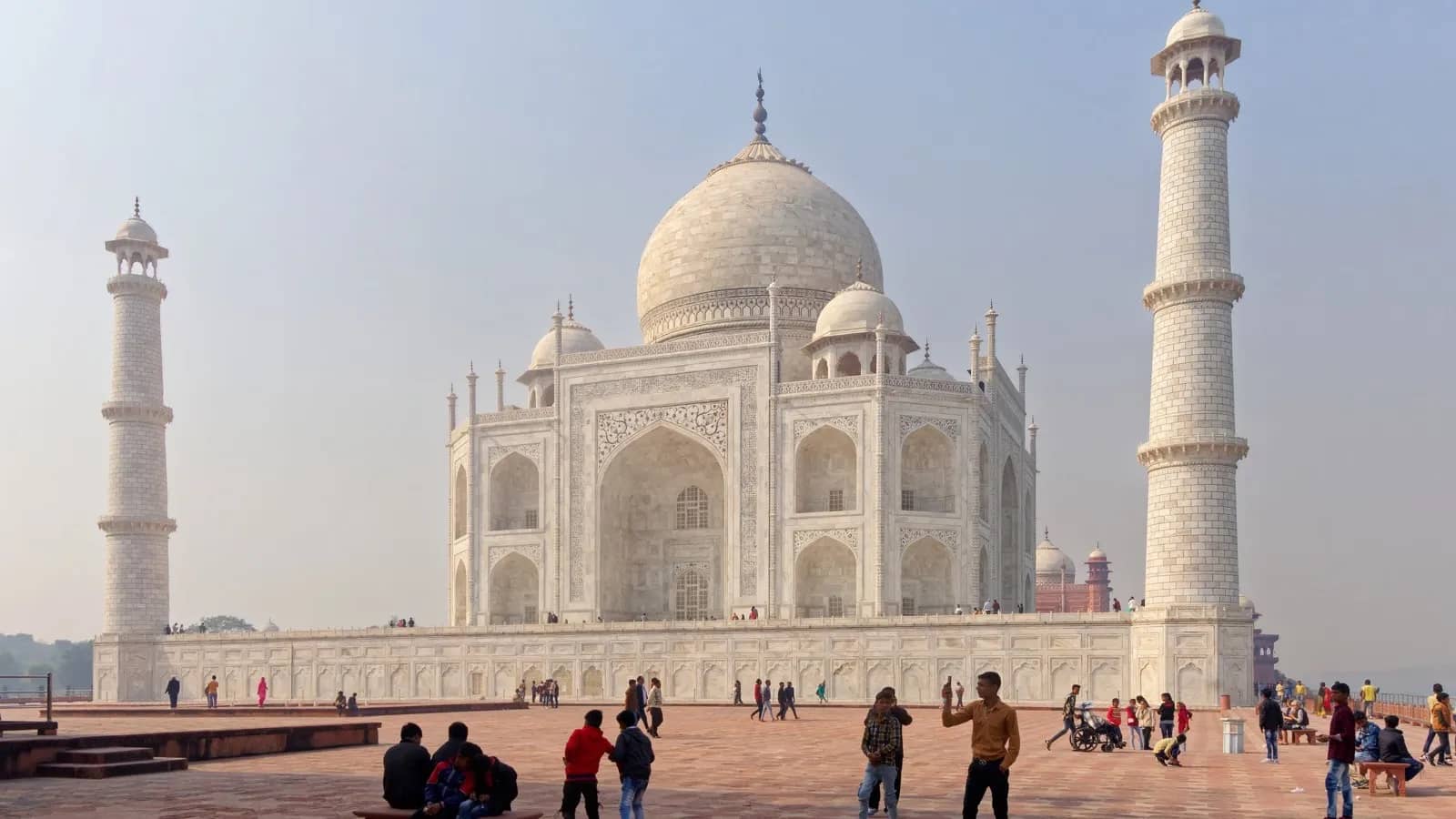
Children cross the formal garden, compare the minarets and inlaid surfaces, and see how the building changes as they move toward it. The strongest fit starts around age six. Budget two to three hours from the gate; parking, security and the non-polluting shuttle approach add more time.
The official site documents wheelchairs and first aid at the ASI office. Battery buses and golf carts connect parking areas with the gates because polluting vehicles are excluded from the immediate area. Strollers may help on the broad approach, but security, crowds, shoe-cover areas and the mausoleum route make a carrier useful. The official page does not promise a changing table.
Water is allowed, while food is prohibited inside. Cloakrooms and shoe racks are available, but large bags increase security time. Use the toilet before joining the main viewing flow and do not expect shade across the marble platform. Sunrise can reduce heat, but it is also a popular arrival period.
The Taj Mahal is closed to general visitors on Fridays. Buy only through an official channel, carry required identification and read the prohibited-item list before leaving the hotel. Use the east or west parking and its battery transport rather than treating Agra Cantt station as the attraction stop. Check the official visiting hours, ticketing page and visitor rules. Official details checked August 28, 2026.
Agra Fort
Children move through gates, defensive walls, courtyards and palace rooms, then find views toward the Taj Mahal. Children of about seven and older tend to get more from the military and Mughal history. Set aside two to three hours and choose priority sections rather than asking a child to inspect every chamber.
The fort includes stone slopes, thresholds and steps. A compact stroller can help on the broadest approaches, but the official visitor pages do not publish a complete stroller or wheelchair route. Contact ASI when step-free access determines whether the family can visit.
The same pages do not clearly confirm a changing table, food service or shade at each stopping point. Use the entrance facilities, carry allowed water and schedule a meal outside the monument. Midday heat and a morning at the Taj are a poor combination for younger children.
Agra Fort uses the official ASI ticketing system and is listed on the Uttar Pradesh Tourism ticket page. Agra Fort railway station is the closest rail reference, while most intercity families arrive through Agra Cantt and need a road transfer. Check the official Agra monument ticketing page before travel. Official details checked August 28, 2026.
Jaipur: group the old city and keep Amber separate
Amber Palace sits outside the central city and needs its own morning. Jantar Mantar and City Palace are neighbours and can share a day, provided the family stops for lunch and drops the third old-city landmark. A Hawa Mahal photo is not a reason to add another full ticketed visit.
Amber Palace
Children cross successive courtyards, compare public and private spaces and look for the mirror work of Sheesh Mahal. Older primary-age children and teenagers are better placed for the scale, story and walking. Keep two and a half to four hours for the approach and visit.
The palace is on a hill and contains slopes, steps and uneven historic surfaces. A car can enter through Chand Pol, while buses from central Jaipur serve the area. The Rajasthan Tourism page does not publish a complete step-free circuit, stroller policy or current wheelchair arrangement. Confirm the entry route directly when mobility matters.
Toilets and refreshments may be available in the wider complex, but the official page does not document baby-changing, food and seating with enough precision to promise them at the moment a family needs them. Carry water, plan shade and avoid the exposed middle of a hot day. Do not build the transport plan around an elephant ride; a car, bus or confirmed jeep transfer is predictable and does not depend on animal use.
Advance entry is useful in holiday periods, while the uphill vehicle arrangement needs to be settled separately. Rajasthan Tourism says buses from Ajmeri Gate and MI Road take about 40 minutes before traffic variation. Read the official Amber Palace page. Official details checked August 28, 2026.
Jantar Mantar Jaipur
Children use giant stone instruments to ask how people measured time, position and movement before phones and satellites. A guide or audio explanation turns abstract shapes into a working science lesson. This lands best from about age eight. Plan one and a half to two hours.
Much of the observatory is an open, comparatively level site, but some instruments and viewing angles involve steps. The current Rajasthan Tourism page does not publish a complete wheelchair route, stroller policy, changing facility or accessible-toilet specification. Families with a specific access need should contact the venue rather than infer it from the wide central paths.
The site has little protection from strong sun or rain. Bring hats and water, and do not schedule it after a long Amber morning. The official page lists on-site and online tickets plus audio guides; a guide is useful because children cannot understand the instruments from their shapes alone.
Jantar Mantar sits beside City Palace in the old city. Badi Chaupar is the useful metro reference, followed by a walk through busy streets. Check the official Jantar Mantar visitor page. Official details checked August 28, 2026.
City Palace Jaipur
Children move between courtyards and museum galleries containing royal clothing, weapons and decorative art. From about seven, they can choose a theme and avoid museum fatigue. Two to three hours covers the standard museum visit without adding every premium interior option.
This is a working heritage complex with different buildings and thresholds. The current official visit page does not give enough detail to guarantee step-free entry to every gallery or easy stroller movement through every doorway. Ask the museum about the exact ticket route if a wheelchair, lift or quiet entry is essential.
Toilets exist within the wider complex, but the current public page does not clearly promise a changing table, accessible cubicle, cafe seat or shaded rest point on every ticket path. Use the facilities when you pass them and plan lunch outside the exhibition flow. Festival dates and school holidays can concentrate visitors at photogenic gates.
The museum publishes a ticket-window cutoff and daily visitor hours, which should be rechecked before travel. It is next to Jantar Mantar, so both can share one old-city day with a real lunch break. Use Badi Chaupar as the metro reference. Read the official City Palace visit page and Rajasthan Tourism overview. Official details checked August 28, 2026.
Ranthambore: wildlife replaces a city day
Ranthambore is not a side trip that can be squeezed between breakfast and a Jaipur dinner. Give Sawai Madhopur two nights so a late train or road delay does not erase the safari.
Ranthambore Tiger Reserve
Children scan grassland and woodland from a permitted vehicle, learn to identify deer, birds and tracks, and practise waiting without a guaranteed result. Our planning range starts around age seven. Allow half a day once hotel pickup, checks, the safari block and zone travel are counted.
The Rajasthan Forest booking system describes six places in a gypsy and twenty in a canter. A stroller is not useful inside either vehicle. The official booking pages do not promise a wheelchair transfer, child seat, accessible toilet during the drive or a particular vehicle position. Ask the operator about transfer ability before purchase.
Use the toilet before departure and carry only permitted essentials. Dust, cold early mornings, heat later in the day and vehicle movement all affect children. Food and free movement are not available during the safari. Prepare the child to enjoy deer, birds and landscape; a tiger sighting is never part of the ticket promise.
Book through the Rajasthan Forest route, keep the same identity document used for the permit and verify the named pickup point. Sawai Madhopur is the rail and accommodation base. Check the official safari booking page and permit instructions. Official details checked August 28, 2026.
Kerala alternative: choose it instead of the northern circuit
Periyar represents a different first trip. Pair Thekkady with Kochi and one slower Kerala base; do not fly south only to collect this boat after Rajasthan.
Periyar Tiger Reserve boating
Children take a scheduled boat across Periyar Lake and look for deer, gaur, otters, elephants and birds along the shore. The useful experience is observing carefully, not expecting a tiger. Children from about five can manage the one-and-a-half-hour boat. Reporting and internal transport bring the full block to roughly two and a half to three and a half hours.
The boat rules require life jackets and prohibit standing during the trip. Visitors leave their vehicle at Anavachal and use the reserve's bus for the roughly four-kilometre journey to the landing. A stroller is cumbersome across that sequence, and the official page does not guarantee a step-free bus-to-boat transfer. Ask before booking when a passenger cannot manage steps or transfer independently.
The official listing confirms toilets, a drinking-water kiosk, an eco shop, life jackets and binocular rental. It does not promise a baby-changing station or food during the boat trip. Use the toilet before boarding and keep a child seated even when wildlife appears on the opposite side. Check the same-day weather and carry a light rain layer for the outdoor bus and boarding sequence.
Advance booking protects the timed place, but the family must still report at Anavachal one hour before departure and reach the landing on time with the booked identity document. Thekkady is the practical base. Read the official Periyar boating page. Official details checked August 28, 2026.
Five days: Delhi and Agra without a Jaipur sprint
Day 1: Arrive in Delhi. Eat near the accommodation, sleep and keep the first evening free. Do not attach a timed monument to an international arrival.
Day 2: Visit the National Rail Museum in the morning. After lunch and a rest, choose a short garden or neighbourhood walk. The museum and Qutb Minar are not a natural same-day pair for a tired preschooler.
Day 3: Visit either Humayun's Tomb or Qutb Minar early. Take an afternoon train or reserved car to Agra and stop after check-in.
Day 4: Use the reserved Taj Mahal entry. Eat, rest and add Agra Fort only when the children actively want another monument and the weather is suitable.
Day 5: Depart Agra for Delhi or the next transport hub. Protect a large buffer before an international flight.
Seven days: a slower Golden Triangle
Day 1: Arrive Delhi and recover.
Day 2: National Rail Museum, lunch and a free afternoon.
Day 3: Humayun's Tomb or Qutb Minar, not both by default. Pack after the rest block.
Day 4: Travel to Agra. Use Agra Fort only if the arrival is early and calm; otherwise move it to day five.
Day 5: Taj Mahal in the morning, then a long break. Travel to Jaipur late in the day only with a trusted driver and a child who handles road journeys. Otherwise sleep in Agra and leave early on day six.
Day 6: Amber Palace in the morning. Return to the hotel for lunch and rest; do not add the full old-city pair.
Day 7: Choose Jantar Mantar or City Palace before departure. If the flight leaves from Delhi, this itinerary needs another transfer buffer or an eighth night.
Ten days: Golden Triangle and Ranthambore
Day 1: Arrive Delhi and stop.
Day 2: National Rail Museum and a flexible afternoon.
Day 3: Humayun's Tomb or Qutb Minar, followed by the train to Agra.
Day 4: Taj Mahal and a protected afternoon.
Day 5: Agra Fort, then a reserved road transfer to Jaipur with toilet and meal stops agreed in advance.
Day 6: Amber Palace, lunch and rest.
Day 7: Jantar Mantar and City Palace with a real midday break. Remove one if the children are already tired.
Day 8: Travel to Sawai Madhopur and check the permit, pickup point and identity documents. Do not add an evening wildlife excursion after a delayed road trip.
Day 9: Use the booked safari block. A second drive should depend on child interest and permit availability, not on trying to force a tiger sighting.
Day 10: Travel toward Delhi or Jaipur for departure. Do not pair a long road or rail transfer with a tightly timed international flight. Add an eleventh night near the airport when the connection is not recoverable.
For a younger-child trip, replace this entire outline with a Kerala week. A workable pattern is Kochi, Thekkady and one backwater or beach base. Flying from Rajasthan to Kerala inside ten days creates another trip, not a relaxing extension.
Transport in India with children
When a driver helps and when a train is better
Do not rent a self-drive car for this core route unless the driver already understands Indian road conditions. Delhi Metro and reserved rides cover the city. A daytime train can make Delhi to Agra simpler than a road transfer. A booked car and driver earns its place between Agra, Jaipur and Ranthambore because it allows toilet, food and motion-sickness stops.
Approximate planning ranges are one hour forty-five minutes to two and a half hours for a fast Delhi-Agra train, three and a half to five hours by road from Delhi to Agra, four to five hours from Agra to Jaipur and three and a half to four and a half hours from Jaipur to Sawai Madhopur. These are itinerary estimates, not timetables. Traffic, station choice, road works and train performance change the actual day.
Foreign visitors can register with IRCTC, verify an international number and book eligible tickets with passport details. IRCTC says foreign-tourist quota bookings can be made farther ahead than the standard reservation period, with berths allocated later when required. Keep the passport used for the reservation available. Read the official foreign tourist booking guide and e-ticket instructions.
Reserve the child restraint in writing
Section 194B of India's Motor Vehicles Act covers a child under fourteen who is not secured by a safety belt or child restraint system. Separate Central Motor Vehicles Rules address an appropriate restraint for a child up to twelve in specified M1 vehicles. Vehicle class, date and transport-category details matter, so this guide is not a substitute for current legal advice.
For a private car or airport transfer, give the provider the child's height, weight and age and obtain written confirmation of the restraint. Ask for the model when possible. A request note is not proof that the driver will arrive with the correct seat. App rides and taxis should not be assumed to carry one.
Read the official India Code section on safety belts and children and the Central Motor Vehicles notification before travel.
Delhi airport, railway luggage and strollers
Delhi's Airport Express links Terminal 3 with New Delhi station. Terminal 1 uses a different metro connection, so read the flight terminal before choosing a hotel-to-airport route. A direct prebooked transfer is usually easier after a long flight when the family needs a verified restraint, carries several bags or arrives outside the child's normal day.
Indian Railways applies class-based luggage allowances and dimensions. Children aged five to under twelve receive half the adult free allowance, capped by the published rule. Oversized items may need the luggage office or brake van rather than the passenger compartment. A folded stroller is not automatically exempt from space and handling constraints; keep it compact and confirm the operator's current rule. Use the official Indian Railways luggage rules.
For every transfer, keep medicines, one change of clothes, wipes, water treatment backup and a comfort item in hand luggage. Do not put the only copy of the next ticket or hotel address in a checked bag.
Seasons, meals and everyday family logistics
Heat, monsoon, air pollution and school holidays
October through March is often the practical window for the northern circuit because daytime heat is lower, but Delhi can experience severe air pollution from October into February. The United Kingdom's current health advice identifies children and people with pre-existing conditions as groups who may be especially affected. Check local air-quality guidance each day, discuss respiratory conditions with a clinician and move or cancel outdoor plans when official advice says conditions are unhealthy.
April through June can make exposed monuments exhausting or unsafe in the hottest hours. Monsoon conditions vary by region and can disrupt roads, flights and outdoor visits. Use the India Meteorological Department's MAUSAM forecasts and warnings for each base rather than a national monthly average.
Indian school calendars vary by state and school. Summer holidays, Diwali, Dussehra, Christmas and New Year can increase domestic demand, while local festivals affect one city more than another. Book the Taj, trains and wildlife permit first, then keep at least one unbooked half-day.
Meal timing and child-friendly food
Breakfast is usually straightforward at hotels. Lunch can drift into early afternoon and dinner may begin later than a young child's routine. A substantial lunch, fruit the adults can peel and a simple early meal near the accommodation can prevent the evening from depending on a busy restaurant.
Plain rice, dal, roti, idli, dosa and simply cooked vegetables can be useful starting points. "Not spicy" does not answer allergy questions, and recipes vary by kitchen. Ask about nuts, dairy, gluten and cross-contact directly. Yogurt, cut fruit, chutney and ice are not automatically safe because they look familiar.
Health, pharmacies, water and animals
Arrange a route-specific travel-health appointment at least a month before departure when possible. Vaccine, malaria and mosquito advice depends on the child's age, health, season and exact states. The CDC India page also advises travellers to avoid unfamiliar dogs, cats and wild animals because rabies needs urgent medical care after an exposure.
Do not drink tap water. CDC's India guidance recommends boiled, bottled or filtered water and safe food habits. Check the seal, use a reliable treatment method and apply the same rule to tooth brushing when the accommodation cannot confirm the source. Seek medical advice promptly when a child cannot keep fluids down, shows dehydration, has blood in stool, breathing trouble or another urgent symptom.
Pharmacies are common in major cities, but brand names, formulations and quality controls differ. Carry enough prescribed medicine in original packaging, plus the prescription and child dosing instructions. Do not substitute a locally offered medicine for a child's usual product without qualified advice.
India's integrated emergency number is 112. The government says it covers police, fire, health and other urgent assistance in all states and union territories. Save the accommodation address and the nearest suitable clinic offline. The 112 India app can send a location-based request, but an app is not a reason to delay a direct emergency call.
Useful apps for an India family trip
Install only what the route needs, then keep a non-app backup.
- IRCTC Rail Connect: search, book, view and cancel Indian Railways tickets through the official service. Keep the e-ticket and passport available offline.
- Delhi Metro Sarthi (Momentum 2.0): use the official DMRC app for route planning and eligible QR ticket functions. Confirm the terminal and final walk separately.
- MAUSAM: use the India Meteorological Department's location forecasts, warnings and nowcasts rather than a generic India-wide forecast.
- 112 India: keep the official emergency app as a location-enabled option alongside the 112 number.
- Google Maps: download Delhi, Agra, Jaipur, Sawai Madhopur or Kerala areas and pin the exact attraction gate, not only the attraction name.
- Google Translate: download Hindi and the language relevant to the state. Save allergy, restraint and medical phrases before travel.
- The operating airline app: terminal, gate and luggage notifications belong with the airline operating the flight, not only the company that sold it.
- WhatsApp: save the hotel and confirmed driver, but verify a contact through the official booking record before sharing passports or payment details.
Connectivity without making the route depend on signal
Families use mobile data for station changes, driver contact, weather warnings, ticket retrieval, translation and regrouping after a split activity. Download every hotel address, attraction ticket, rail PNR, insurance detail and one map before leaving WiFi. Mobile service can weaken inside stone buildings, between cities or when a crowded venue overloads a local cell.
The live Roaming eSIM package endpoint reviewed on August 28, 2026 listed 16 India packages. The cards disclosed Airtel, Idea, Jio, Vi India and Vodafone across the available India options, with package labels reaching up to 5G where the plan and local operator support it. Fifteen plans supported top-up and one did not. Those are package-level disclosures, not a promise that five networks are available to one phone at every address or that a 5G connection will appear inside a fort.
For an India-only trip, begin with the India Roaming eSIM page. An Asia plan makes sense only when the exact countries on the itinerary appear in that plan's current coverage list. A global option is useful only when its wider route justifies the difference. Four visible product cards are the limit here because another near-duplicate choice would not help a family decide.
Roaming eSIM's practical edge is preparation and support. A compatible, unlocked iPhone, Samsung, Pixel or Motorola phone can keep the usual SIM in place, while My eSIMs provides one-tap, QR and manual installation details. The public support centre lists 24/7 help and WhatsApp contact. The selected package card still controls data, validity, operator access, hotspot use, activation, daily high-speed limits and whether that plan can be topped up.
Why Roaming eSIM is a better India fit than the Motorola Global Connect launch story
Motorola Global Connect is convenient for an eligible Motorola owner, but the launch reviewed in our news article named five Latin American purchase markets and required a compatible Motorola phone. India was not one of those named purchase markets. Coverage of many travel destinations is not the same as being able to buy the service from India or on a non-Motorola device.
Roaming eSIM publishes a direct India catalog, regional alternatives and package fields before checkout without tying the purchase to one phone brand. It also publishes 24/7 support. That makes it the broader, verifiable choice for a mixed-phone family planning India. It is not a claim that Roaming eSIM is cheaper in every live comparison or that every plan is reloadable. Read the Motorola Global Connect analysis for the named launch limits.
Estimate the trip with the travel data calculator, read when to install a Roaming eSIM, check phone compatibility and compare country with regional coverage. One adult arranging data for several phones should also use the family eSIM setup guide. Families continuing east can use Thailand with kids or Malaysia with kids for the next part of their trip.
Sources and updates
Before departure, recheck transport, child-restraint requirements, health advice, air quality, monument access and reserve rules for your India route.